


 Čeština

Popular categories
- News
- Recommended
- For investors
Popular types of stones
Other categories

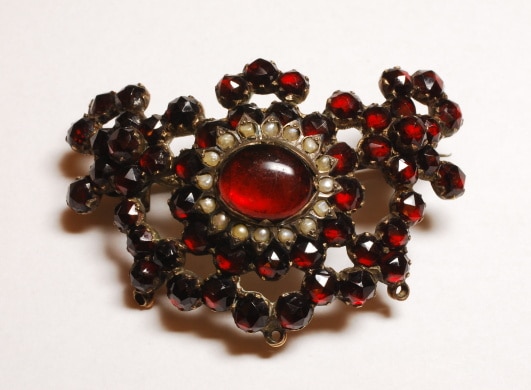
Cleaning and restoration of old jewellery with Czech garnet or how to save a garnet jewel. First of all, it should be noted that no instruction is universal, so it is advisable to leave cleaning and maintenance to an expert. The problem may be where to find such an expert. For this reason, we take the liberty of describing here some basic steps to clean and restore a piece of jewelry.
Old jewellery with Czech garnets is usually made of base metal (mostly tombak – tombak is the name of an alloy of copper (84-90%) and zinc (10-16%), i.e. brass with a higher copper content), less often also of silver and rarely also of gold.
When cleaning the jewellery, it is necessary to remove mainly classic dirt (remnants of hand cream, soap, old leather, textile fibres, dried raw dough and other usually hardened raw food blanks).In the case of earrings, dried earwax (which flows out of the ears spontaneously) mixed with shampoo is also common. To a lesser extent, oxidation products of the metal may also occur on the jewellery.
Classic dirt is best removed in warm water (NOT HOT AND NOT EVEN BOILING – too hot water can irreversibly ruin the jewellery). The temperature of warm water is max. 40°C. It is also advisable to use an old soft toothbrush. It is very important not to perform the whole operation over the sink, because garnets usually do not stick very well in the jewellery and therefore it is advisable to use a deep plate or even better a plastic bowl. Because if the garnet is removed from the jewellery, the garnet will be lost in the sink if it is cleaned in the sink. Whereas when using a bowl, the garnet is easily found in the bowl.
When cleaning the jewellery in warm water, it is advisable to use a jar (this will reduce the surface tension on the stones and metal, and the dirt will “peel off” better). After removing the jewellery from the bowl, it is important to dry the entire piece thoroughly to avoid water logging. Extra care should be taken when drying, as especially for garnet jewelry set in kettles (i.e., the stone is not visible from the bottom of the jewelry), it can cause the backing to become warped. These washers – usually newspapers – were used to flatten the cut Bohemian garnet into a single plane in the jewel. The reason for this was that previously Bohemian garnets were cut very imperfectly, the facet bonding was very poor as was the symmetry, doling, etc., because Bohemian garnet cutters respected the natural shape of the natural garnet grain. Today garnets are cut in a completely different way, each piece has a perfect shape, errors on individual cut stones are rather rare. Previously, therefore, the main work was mainly on the shoulders of the jewellers of the time, who had to perfectly align the Czech garnets in the jewellery so that none stood out, even though each stone was different in height. It was for this “height comparison” that small pieces (about 1.5 x 1.5 – 3 x 3 mm) of newspaper were used. These newspapers were finally covered with a piece of Al, Sn foil to ensure a sufficiently light reflecting surface.
I definitely don’t recommend using ultrasound to clean garnet jewellery, as it could definitely destroy jewellery in worse or downright bad condition.
But what to do if you are missing a Czech grenade? In this case, you have two options:
contact current garnet jewellery manufacturers and ask them to make you an identical or at least very similar stone. This option has two major pitfalls – most garnet jewellery manufacturers do not want to delay in sending one 2 mm stone, because the price of postage and shipping is many times more expensive than the price of the Czech garnet itself. The second problem is that a newly cut Czech garnet does not fit in with the old ones, because it has a much more perfect cut and thus stands out from the rest of the garnets.
The other option is to contact us (info@e-gems.cz) and we will try to find a Czech garnet just for you. The Czech garnets we offer here come from the estates of old cutters, most of these stones were cut over 100 years ago. There are many errors in cut quality and symmetry on these Czech garnets. But when you have a jeweler set (facet) such a Czech garnet with many “flaws” into an antique garnet jewelry piece, the newly added stone blends in completely with the other original stones in the jewelry.
In order to be able to find the right stone for you in our offer, we necessarily need to know:
a) size – this is best measured using a sliding scale (slide). We need to know the size to tenths of a millimetre (e.g. 2.1 mm). Most round old stones are conical. Please tell us here that you need a round Czech garnet with a size of e.g. 2.1 to 2.3 mm.
b) type of grinding wheel – please use the picture here
 |
 |
| routa | diamond |
 |
The rosette (star cut) is one of the modern types of faceted cuts, it can be imagined as two routs rotated 180° to each other, so that their lower surfaces touch. |
| cabachon | rosette |